 MeloAuto-Trusted PLC & DCS Parts Supplier
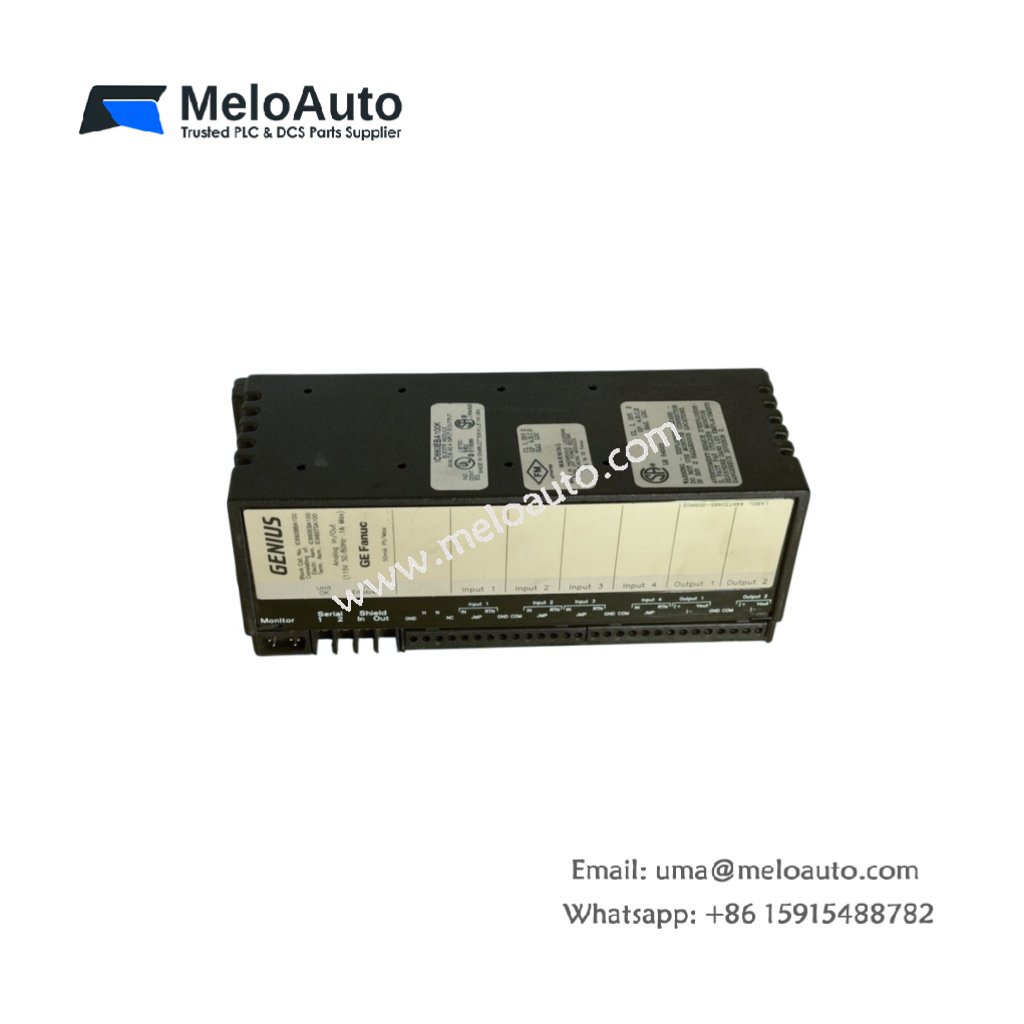
The GE IC660EBA105 provides four analog output channels for Genius I/O systems. This block converts digital commands from the bus controller into continuous process signals. Therefore, it controls valves, dampers, and variable frequency drives in distributed control networks.
Product Overview
We designed this analog output block for mounting directly on machines or near field devices. Its rugged housing withstands industrial environments without additional enclosures. Moreover, this unit includes Genius bus communication for remote I/O applications.
Technical Specifications
| Parameter | Specification |
|---|---|
| Dimensions | 20.0 cm (height) x 12.0 cm (width) x 7.0 cm (depth) |
| Weight | 0.85 kg (approximately 1.87 lb) |
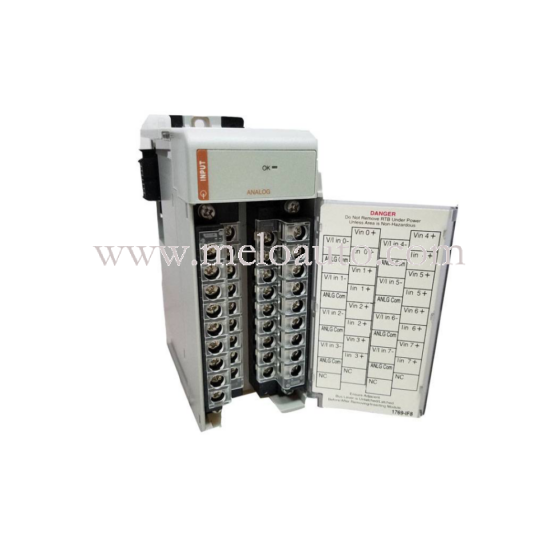
| Interface Type | Genius bus connector plus 16-position terminal block |
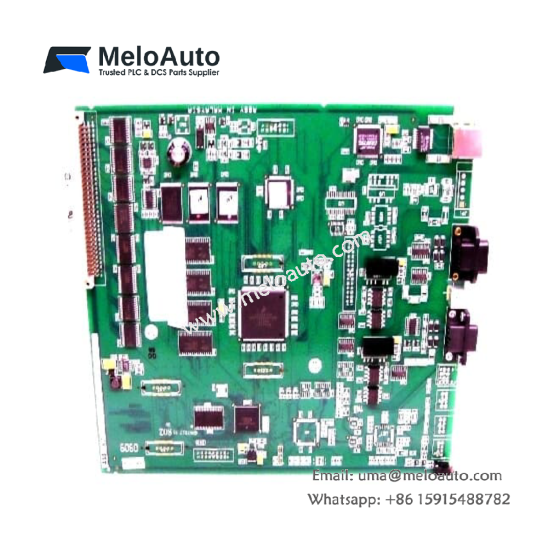
| Component Count | 142 components including DACs and isolation circuits |
| Energy Storage | 6 aluminum capacitors (220 µF, 35V) plus 12 ceramic |
| Output Channels | 4 independently configurable analog outputs |
| Output Ranges | 4-20mA only (single range) |
| Resolution | 12 bits (4 µA per count) |
| Update Rate | 10 ms maximum for all channels |
| Output Accuracy | ±0.25% of full scale at 25°C |
| Output Drive | 750 ohms maximum load at 20mA |
| Loop Power | External 24V DC supply required |
| Protection | Short-circuit and reverse polarity |
| Isolation | 1500V RMS between field and logic |
Output Stage Design
The GE IC660EBA105 uses a single DAC multiplexed across all four channels. Its six aluminum capacitors filter power for the output drivers. Additionally, twelve ceramic capacitors decouple noise from the precision reference circuit. You get stable current outputs with minimal ripple for process control.
Energy Storage Configuration
Six aluminum capacitors provide 20 ms of hold-up during bus power dips. Twelve ceramic capacitors filter high-frequency noise from each output channel. Each output receives dedicated filtering for loop stability. Clean power ensures accurate control of sensitive final control elements. Capacitors also absorb voltage spikes from long cable runs.
Output Configuration
All four channels operate as 4-20mA current sources only. The block requires an external 24V DC supply for loop power. Connect the supply positive to terminal 1 and negative to terminal 2. Each channel draws loop power from this external source independently. The block does not produce loop power internally for any channel.
Installation Steps
Mount this block on a DIN rail or directly to a panel using four M5 screws. Connect the Genius bus cable to the 7-pin circular connector. Then connect 24V DC loop power to the two-pin power terminal block. Connect each output device to its corresponding two-pin terminal pair. Finally, configure the block address using the rotary switches on the front.
Terminal Assignments
Terminals 1 and 2 accept external 24V DC loop power input. The block does not use terminals 11 through 16.
Genius Bus Configuration
Set the block address using the two rotary switches on the front. The left switch sets the tens digit (0-7) for addresses 0-79. The right switch sets the ones digit (0-9) for the same range. Valid addresses range from 0 to 79 on a single Genius bus. No two blocks can share the same address on the same network. The block reads the switches only during power-up.
Diagnostic Features
The block reports an open circuit on any current output channel. It detects this condition when the loop current falls below 1 mA. A short circuit triggers an overload fault and output shutdown. The block automatically resets after removing the short circuit condition. Diagnostic information travels on the Genius bus to the controller.
Application Scope
This analog output block suits remote I/O applications in process plants. Many facilities use the GE IC660EBA105 for valve positioner control. Its distributed design reduces wiring from field devices to the main control room.





WeChat
Scan the QR Code with wechat