 MeloAuto-Trusted PLC & DCS Parts Supplier
Overview
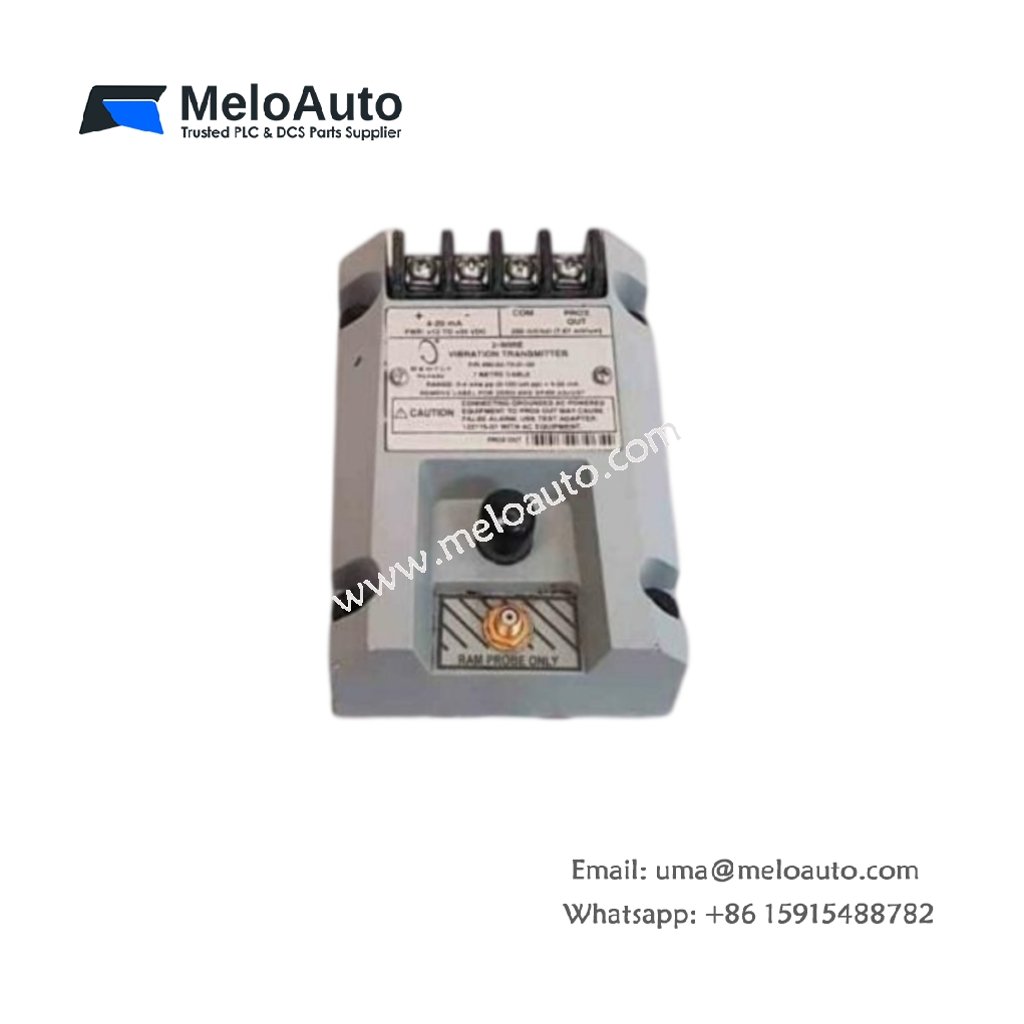
The 990-04-70-01-00 belongs to the Bently Nevada 990 series, a family of two-wire vibration transmitters. Engineers rely on this device to monitor shaft vibration continuously on turbines, compressors, and pumps. Consequently, it produces a 4–20 mA output proportional to vibration velocity, which integrates directly with DCS and PLC systems.
Key Technical Specifications
The 990-04-70-01-00 combines a proximity probe driver and signal conditioner inside one housing. Moreover, it satisfies API 670 machinery protection requirements. The table below lists the core parameters.
| Parameter | Specification |
|---|---|
| Product Type | Two-wire vibration transmitter |
| Series | Bently Nevada 990 |
| Full-Scale Range | 0–25 mm/s (0–1.0 in/s) RMS |
| Output Signal | 4–20 mA, loop-powered |
| Frequency Response | 4 Hz to 1,000 Hz |
| Supply Voltage | 12–35 VDC |
| Operating Temperature | –35 °C to +85 °C |
| Storage Temperature | –40 °C to +100 °C |
| Humidity | 0–95%, non-condensing |
| Housing Material | 316 stainless steel |
| Weight | Approximately 0.45 kg (1.0 lb) |
| Dimensions | 25 mm diameter × 105 mm length |
| Mounting Thread | 3/8-24 UNF |
| Connector Type | 3-pin MIL-style circular |
| Cable Length (std.) | 5 meters |
| Compliance | API 670, CE, ATEX optional |
Installation and Interface Details
Mounting the 990-04-70-01-00 requires a standard 3/8-24 UNF threaded hole. The unit then connects through a 3-pin MIL-style circular connector. Furthermore, the two-wire loop simplifies wiring considerably, because power and signal share one conductor pair. As a result, installation costs drop compared with conventional four-wire systems.
Signal Conditioning and Output
Internally, the transmitter converts eddy-current probe signals into a conditioned 4–20 mA output. The frequency response spans 4 Hz to 1,000 Hz, covering most rotating machinery applications. Additionally, the loop-powered design draws under 25 mA, so it suits hazardous-area installations when paired with appropriate safety barriers.
Environmental and Mechanical Ratings
The 316 stainless steel housing resists corrosion in harsh plant environments. It operates reliably from –35 °C to +85 °C. Meanwhile, the sealed construction tolerates 0–95% relative humidity without condensation problems. Consequently, the device performs well in steam turbine rooms and offshore platforms.
Why Engineers Choose This Transmitter
This transmitter delivers several practical advantages. First, it merges probe driving and signal conversion into a single unit. Second, it meets API 670 requirements for vibration monitoring. Third, its compact footprint fits tight mounting locations. Therefore, maintenance teams reduce spare-part inventory and wiring complexity.







WeChat
Scan the QR Code with wechat